Tuesday, June 09, 2009
Social Engineering in the Scriptures
Read the article "Social Engineering in the Scriptures"
Saturday, April 04, 2009
What does "succor" mean?
I'm finally updating this blog again because I've been watching the General Conference of The Church of Jesus Christ of Latter-day Saints, a semiannual conference in which the prophet[?], apostles, and other Church leaders speak to the whole world. One of the words that was used repeatedly during the Saturday morning session (particularly in President Henry B. Eyring's talk) was succor. I don't think I've ever heard this word used outside of a Church setting, so I felt it might be useful to explain what the word means.
Oxford American Dictionaries defines succor as "assistance and support in times of hardship and distress" or as a verb, to "give assistance or aid to."
The word succor should not be confused with the word sucker which is pronounced the same way and has a rather opposite meaning. As a noun, a sucker can be defined among other things as "a gullible or easily deceived person," or as a verb, to "fool or trick (someone)" (ibid.). The word sucker is almost never used in an LDS context so as to avoid confusion with the scriptural and oft-used word succor.
Monday, October 08, 2007
Mitt Romney is a Mormon... So What?
Note: The Church of Jesus Christ of Latter-day Saints has a long-standing policy of political neutrality, and it does not sponsor or endorse any political party or candidate.
Monday, July 02, 2007
Introduction to Mormonism Podcast
Wednesday, March 22, 2006
So You'd Like to... Become a Religious Scholar
Here's another guide I wrote for Amazon.com recently. I have found these titles to be useful aids in seeking to learn more about religion.
The Holy Bible (King James Version) with Apocrypha
The Holy Bible is the Book of Books. It contains the teachings of Jesus Christ, the Savior and Redeemer of mankind, and the words of his prophets and apostles from the creation of the world through the first century A.D.
This edition also contains the Apocrypha, several books that are accepted as canonical by the Catholic Church and other churches, although much of the Christian world excludes them from the canon. At the least, these additional books are interesting to read and enhance the historical background of the Bible, and they are worth reviewing. 'The Bible: Authorized King James Version with Apocrypha'
Strong's Exhaustive Concordance of the Bible
Bible scholars can benefit greatly from Strong's Exhaustive Concordance with Greek and Hebrew dictionaries. This book is a reference volume that lists every instance of each word from the King James Bible. Each instance of each word refers the reader to the book's Hebrew or Greek dictionary, making it easy to find alternate translations of the original words 'Nelson's Super Value Series : New Strong's Exhautive Concordance'
Religions of the World: A Latter-day Saint View
This book delivers a fair, in-depth, and very well-researched look at the world's major religions, including several faiths I had never heard of previously. A must-read volume for those interested in learning more about other religions. 'Religions of the World: A Latter-Day Saint View'
Jesus the Christ
In this book, author James E. Talmage gives an excellent, carefully-researched biography of the Savior. It is filled with brilliant insights into the life and teachings of Jesus and the sociopolitical atmosphere surrounding his life. Unlike other biographies of Jesus, this book covers not only his mortal life but also his premortal and postmortal acts. All those who study the New Testament and the life of Jesus can learn something from this book. 'Jesus the Christ'
The Book of Mormon: Another Testament of Jesus Christ
Latter-day Saints ("Mormons") regard The Book of Mormon: Another Testament of Jesus Christ as a canonical book of scripture comparable to the Bible. It is a record of ancient inhabitants of the Americas, including the writings of their prophets and an account of Christ's ministry there after his resurrection. Mormon prophet Joseph Smith taught that the book is "the keystone of our religion, and a man would get nearer to God by abiding by its precepts, than by any other book." You can get a free paperback edition of The Book of Mormon from www.mormon.org, or you can buy the hardcover Doubleday edition from Amazon. 'The Book of Mormon : Another Testament of Jesus Christ'
The Qur'an (Koran)
Contains the writings of Mohammed, whom Muslims (adherents of the Islamic faith) believe to be a prophet of Allah (God). This particular edition of the Qur'an contains the original Arabic side-by-side with an English translation, as well as a useful topical index in the back, making it an excellent resource for learning about Islam. 'The Holy Quran'
Also look for "Understanding Islam: An LDS Perspective," an audio lecture by Daniel C. Peterson, to learn about some of the parallels between Islam and Mormonism (this title is not currently listed on Amazon.com, but you can order it from Deseret Book).
The Dead Sea Scrolls: A New Translation
The Dead Sea Scrolls are religious texts that date back to the first century A.D. Some of the scrolls contain copies of Biblical writings, and some are copies of extrabiblical and pseudepigraphal writings that claim to have been written by prophets including Enoch.
A few of the authors' commentaries in this book seem a bit questionable or sensational, but the scroll text itself is presented nicely. 'The Dead Sea Scrolls : A New Translation'
The Works of Josephus, Complete and Unabridged
Flavius Josephus, a first-century A.D. Jewish historian, wrote these several works that are useful for learning about Jewish history and beliefs during his lifetime. 'The Works of Josephus: Complete and Unabridged, New Updated Edition'
Free Books
You can get a paperback edition of the Holy Bible (King James Version) or The Book of Mormon: Another Testament of Jesus Christ for FREE from www.mormon.org
Read any of the "standard works" (canonical scriptures) of The Church of Jesus Christ of Latter-day Saints (which includes the Old and New Testaments, Book of Mormon, Doctrine and Covenants, and Pearl of Great Price) at http://scriptures.lds.org
Download free MP3 audio versions of these scriptures from http://www.lds.org/broadcast/scriptures/0,5393,48,00.html
Thursday, March 09, 2006
So You'd Like to... Learn about "the Mormons"
I recently wrote the following guide on Amazon.com. It should be useful for those who would like to learn more about The Church of Jesus Christ of Latter-day Saints and about LDS beliefs.
Latter-day Christianity: 10 Basic Issues
Latter-day Christianity: 10 Basic Issues is an excellent book that demonstrates several important parallels between Mormonism and first-century Christianity, as well as explaining some basic doctrines and responding to common criticisms of The Church of Jesus Christ of Latter-day Saints. 'Latter-Day Christianity: 10 Basic Issues'
The Holy Bible (King James Version)
Latter-day Saints (often called "Mormons" because of their belief in The Book of Mormon) believe that the Holy Bible is the word of God, and the Authorized King James Version is one of the "standard works" (canonical books of scripture) of the Church. Although Latter-day Saints do not regard the Apocrypha as canon, they believe that some Apocryphal books contain useful information. 'The Bible: Authorized King James Version with Apocrypha'
The Book of Mormon: Another Testament of Jesus Christ
The Book of Mormon: Another Testament of Jesus Christ is another of the canonical books of The Church of Jesus Christ of Latter-day Saints. It is a record of ancient inhabitants of the Americas, including the writings of their prophets and an account of Christ's ministry there after his resurrection. The Prophet Joseph Smith taught that it is "the keystone of our religion, and a man would get nearer to God by abiding by its precepts, than by any other book." This volume of sacred scripture is dedicated to Native American "Indians" (the descendants of the book's people) and to both Jews and Gentiles (that is, non-Jews), "to the convincing of the Jew and Gentile that JESUS is the CHRIST, the ETERNAL GOD, manifesting himself unto all nations." You can get a free paperback edition of The Book of Mormon from www.mormon.org, or you can buy the hardcover Doubleday edition from Amazon. 'The Book of Mormon : Another Testament of Jesus Christ'
Our Search for Happiness
Written by a latter-day apostle of the Lord Jesus Christ, M. Russell Ballard's book Our Search for Happiness is the first book I read when I began studying the Church. 'Our Search for Happiness'
The Life and Teachings of the Prophet Joseph
Learn about the life of the man who was the first prophet of modern times, Joseph Smith, Jr., in this popular audio lecture series by Dr. Truman G. Madsen. 'The Life and Teachings of the Prophet Joseph'
Standing for Something: 10 Neglected Virtues
Standing for Something: 10 Neglected Virtues That Will Heal Our Hearts and Homes is an inspirational volume written by the current living prophet of God, Gordon B. Hinckley. 'Standing for Something : 10 Neglected Virtues That Will Heal Our Hearts and Homes'
Free Books
In addition to these great items, you can also get a free paperback copy of the Holy Bible (King James Version) or The Book of Mormon from www.mormon.org
Sunday, August 14, 2005
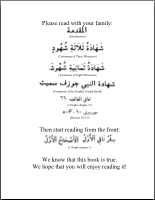
Arabic Book of Mormon Scriptures
Fortunately, after comparing the Arabic and English translations, I was able to learn just enough to decipher the characters necessary to write down selected passages. I spent a few minutes scanning the Arabic words and characters into my computer, and I arranged them appropriately to create a nice, printable list of suggested readings.
For the benefit of others who might want to share an Arabic Book of Mormon with a friend, I decided to post a PDF copy of my suggested readings list for anyone who wants it. The suggested passages include the Introduction, the Testimony of Three Witnesses, the Testimony of Eight Witnesses, the Testimony of the Prophet Joseph Smith, 3 Nephi 11, Moroni 10:3-5, and 1 Nephi 1. Obviously I didn't know how to write in Arabic things like "start from the beginning once you've read the preceding passages," so I wrote those parts in English; hopefully either the reader understands some written English or can have someone else translate those comments. If not, at least it should be clear enough that the giver is inviting the receiver to read the parts written in Arabic.Download the Book of Mormon Arabic Suggested Readings List.
Monday, December 06, 2004
Luther
It also made me think a lot about Joseph Smith, the prophet of the Restoration. Had it not been for reformers like Luther, who helped open people's minds to thinking about the gospel for themselves rather than accepting doctrines and practices that had no scriptural basis, it may have been much more difficult for a restoration of the gospel to occur. I am reminded of a statement given by the First Presidency of The Church of Jesus Christ of Latter-day Saints in 1978, quoted by President Faust in the March 2002 Ensign:
"The great religious leaders of the world such as Mohammed, Confucius, and the Reformers, as well as philosophers including Socrates, Plato, and others, received a portion of God's light. Moral truths were given to them by God to enlighten whole nations and to bring a higher level of understanding to individuals. . . . We believe that God has given and will give to all peoples sufficient knowledge to help them on their way to eternal salvation" ("Statement of the First Presidency regarding God's Love for All Mankind," 15 Feb. 1978, qtd. by James E. Faust)President Hinckley, the prophet who leads the Church today, has frequently and openly invited those of other faiths, "You bring all the good that you have and let us see if we can add to it" [1][2][3]. Latter-day Saints respect the work of the reformationists, and are even more grateful for the restoration of the gospel for our time. To learn more about the Restoration, you can get a completely free video (VHS/DVD, US/Canada) from mormon.org that depicts the First Vision and the beginnings of the restoration of The Church of Jesus Christ though the prophet Joseph Smith. You can choose whether to have representatives deliver it or to have it mailed at no cost to you.
And again, if you're at all interested in the history of postbiblical Christianity or the Reformation of the 1500s, I highly recommend that you rent Luther starring Joseph Fiennes from your local video store.
Sunday, September 05, 2004
September 2004 Ensign
Go on, I'll wait.
In the mean time, I'll give links to the articles on which I'll comment below. Okay, now I'd like to share a few things that stood out to me when I read the September issue last night.
In Opposition to Evil by President Gordon B. Hinckley
This is an excellent article, full of pearls of wisdom. Please read it first so you can learn directly from the prophet's words before I point out some parts I found particularly interesting.
To give an overall summary, President Hinckley points out that in many areas of the world today we find media "which is debauching, that which leads to violence and illicit sex." Nevertheless, he is confident that "there are millions upon millions of good people" whose combined voices can turn back the tide of filth in the world. Says he, "I believe the challenge to oppose this evil is one from which members of The Church of Jesus Christ of Latter-day Saints, as citizens, cannot shrink." I think the word "oppose" is significant; we are not to simply avoid evil. We are to oppose it.
"I should like to suggest four points of beginning in our efforts to oppose the tide of evil," President Hinckley continues. He lists and expounds upon these four areas:
- Begin with yourself.
Choice quote: "We cannot expect to lift others unless we stand on higher ground ourselves." - A better tomorrow begins with the training of a better generation.
Expose your children to good books, magazines, and music. "When there is a good movie in town, consider going to the theater as a family. Your very patronage will give encouragement to those who wish to produce this type of entertainment." "Let those who are responsible for any efforts to put suitable family entertainment on television know of your appreciation for that which is good..." - The building of public sentiment begins with a few earnest voices.
"...we should earnestly and sincerely and positively express our convictions to those given the heavy responsibility of making and enforcing our laws." "Remarkable consequences often flow from a well-written letter and a postage stamp." "...be not weary in well-doing, for ye are laying the foundation of a great work. And out of small things proceedeth that which is great. (D&C 64:33)" - Strength to do battle begins with the strength of God.
"Put on the whole armour of God... For we wrestle not against flesh and blood, but against principalities, against powers, against the rulers of the darkness of this world, against spiritual wickedness in high places. Wherefore take unto you the whole armor of God, that ye may be able to withstand in the evil day, and having done all, to stand. (Ephesians 6:10-13)"
Compassion for Those Who Struggle (author's name withheld)
This is an excellent article written by a Latter-day Saint who struggles to avoid the temptation of same-sex attraction. Because I have had friends in the past confide in me about such personal matters, I am always intrigued by Church articles published on the subject.
The author recognizes that becoming engaged in a homosexual relationship or lifestyle is not pleasing to the Lord (see Guide to the Scriptures: Homosexuality), and wishes not to be labeled "gay," but to take upon him- or herself the name of Christ instead (¶ 3). Anyone else who feels similarly, or who wishes to better understand the doctrine of Christ on this subject, should definitely read this article.
Some good quotes:
"Persons... struggling with the burden of same-sex attraction are in special need of the love and encouragement that is a clear responsibility of Church members."
-Elder Dallin H. Oaks of the Quorum of the Twelve Apostles
"Once we have reached the age or condition of accountability, the claim 'I was born that way' does not excuse actions or thoughts that fail to conform to the commandments of God. We need to learn how to live so that a weakness that is mortal will not prevent us from achieving the goal that is eternal."
-Elder Dallin H. Oaks
"If you do not act upon temptations, you need feel no guilt."
-President Boyd K. Packer, Acting President of the Quorum of the Twelve Apostles
"We should always distinguish between sinful acts and inappropriate feelings or potentially dangerous susceptibilities. We should reach out lovingly to those who are struggling to resist temptation."
-Elder Dallin H. Oaks
The author states that he or she becomes uncomfortable when people ask why he or she is not yet married. "Worse, however, is hearing the dreaded words 'I have the perfect person for you to date.'" Nevertheless, the author explains that for some people dating those of the opposite sex may help "to work past inappropriate attractions."
The author continues, "Some may say that same-sex attraction can be 'cured' simply through dating and marriage. But President Gordon B. Hinckley has dispelled this notion: 'Marriage should not be viewed as a therapeutic step to solve problems such as homosexual inclinations or practices, which first should clearly be overcome with a firm and fixed determination never to slip into such practices again.'"
Anyway, subscribe to the Ensign! It's a great way to keep the Spirit in your home and to continually learn more about the gospel.
Sunday, May 30, 2004
Buddhism and Isaiah
The Buddhist monk was quite interesting. He spoke very limited English, but was extremely kind and even allowed us to enter his very elaborate temple (after we had removed our shoes). He showed us his large, brightly decorated Buddha shrine and some scrolls that appeared to be rather old and of great importance to him. We were also given a pamphlet (written by someone else, but also in broken English) explaining some of the practices of Buddhism for novices. (As a token of our gratitude, we brought him a Thai translation of the Book of Mormon the following day.)
There were many Buddhist practices outlined in the pamphlet that should be quite familiar to Latter-day Saints and other Christians. I was studying Isaiah shortly after reading the pamphlet, and I came across a passage that struck me as similar to some things I had just recently read. The following is based on some notes I wrote in my scriptures.
Buddhism
Isaiah 57
The Ten Precepts (or Novice's Precepts) of Buddhism have many similarities to the gospel of Jesus Christ. Two of the more obscure precepts (#8 and 9) seem to possibly coincide with verses 9 and 7 of this chapter of Isaiah.
- I observe the precept to abstain from taking of life [Thou shalt not kill]
- I observe the precept to abstain from taking what is not given [Thou shalt not steal]
- I observe the precept to abstain from sexual intercourse [Outside of marriage? Perhaps relates to law of chastity. If generally intercourse is to be abstained from, may relate to celibacy practice of some Christian faiths]
- I observe the precept to abstain from telling lies [Thou shalt not bear false witness]
- I observe the precept to abstain from drinking intoxicating drinks [Word of Wisdomlaw of health]
- I observe the precept to abstain from taking any food after noon [Perhaps has ties to Jewish customs? May relate to fasting]
- I observe the precept to abstain from dancing, singing, playing music and looking at shows [some Christian religions denounce dancing as abominable]
- I observe the precept to abstain from wearing, decorating or adorning oneself with flowers, scents and cosmetics [Isaiah 57:9 seems to imply that "increasing [one's] perfumes" is abominable. According to the pamphlet, to pay homage "one should make an offering of flowers, candles and incenses to the Buddha image then bow three times to the Buddha image." Frankincense, an ingredient in holy sacrificial incense and also used as a perfume, was offered as a gift to the baby Jesus.]
- I observe the precept to abstain from using of luxurious and high seat and bed [Isaiah 57:7 begins "Upon a lofty and high mountain hast thou set thy bed..." LDS footnote "a" (in reference to "bed") says "IE as an altar for idolatrous use." The Hebrew word from which bed was translated here is mishkâb, "a bed," according to Strong's Exhaustive Concordance of the Bible.]
- I observe the precept to abstain from accepting any gold and money and not to be desirous in spending them [Thou shalt not covet; "the love of money is the root of all evil" (1 Tim. 6:10). Perhaps the first part relates to unpaid ministry.]
Pretty interesting stuff, eh? I'm not implying any particular reasons why similarities might exist between these practices of Buddhism and Isaiah's writings, or between Buddhist practices and those of various Christian faiths; I'm just listing some interesting observations and similarities that I've discovered.
Sunday, May 16, 2004
Work quote from Leonardo da Vinci
"God sells us all things at the price of labor." -Leonardo da VinciHow profound is that quote! Think about who Leonardo da Vinci was -- one of the greatest inventors in history and one of the most intelligent people to walk this earth. And yet, as can be inferred from this quote, he wasn't prideful about his accomplishments. In fact, da Vinci recognized that we can receive any blessing from God, but God expects us to work for it.
I believe this fits well with Jeffrey R. Holland's observation that "salvation is not a cheap experience." If "it was never, ever easy" for Christ, can we expect to not do anything and become joint-heirs with Christ? Paul explained to the Romans:
"The Spirit itself beareth witness with our spirit, that we are the children of God:
And if children, then heirs; heirs of God, and joint-heirs with Christ; if so be that we suffer with him, that we may be also glorified together." (Romans 8:16-17; emphasis mine)
General Thoughts
These are just thoughts of mine, and do not necessarily reflect the teachings or opinions of The Church of Jesus Christ of Latter-day Saints. To learn about the Church and its doctrines from the Church itself, you should start by reading everything available at www.mormon.org, and you may wish to request a visit from the missionaries. They can more thoroughly explain gospel subjects, and they have a lot more time to do so than I do. Missionaries of the Church study the gospel for about 3 hours daily, have devoted 2 years of their lives to full-time missionary service in another part of the world from where they live, and most of them are very knowledgeable about gospel subjects.
That said, here are a couple of the first thoughts I'd like to post.
- If even the prophet and apostles continue to study the scriptures and continue to learn from them, then you and I certainly have a lot to learn.
- Many people feel the Spirit of God strongly as they read and ponder the Book of Mormon: Another Testament of Jesus Christ. Some have had the experience of not being able to put it down until they finish reading it. There is a certain power in that book. As I was in a missionary meeting one day a thought occurred to me. The Book of Mormon is concentrated gospel. Concentrated in the same sense as concentrated orange juice. When the prophet-historian Mormon (after whom the book is named) abridged the ancient record of the Nephites, Mormon recorded the most important things in his abridgment. Once you gain a testimony of the truthfulness of the book by the power of the Holy Ghost (see Moroni 10:3-5), it is so important to continue to study the record on a regular basis -- daily when possible -- to continue to receive light and truth from the Christ-centered messages it contains.